
CAC Mastery for Early Startups: Calculate, Cut and Scale in 2026
In the brutal funding winter that carried over into 2026, early-stage founders are discovering that a clean CAC number can be the difference between runway and runway lights. Customer Acquisition Cost is no longer a vanity metric scribbled on a pitch deck. It has become the single operating lever that determines whether your startup survives the next twelve months or joins the growing list of quiet shutdowns.
Most first-time founders still calculate CAC the lazy way: divide last month’s marketing spend by new customers. That approach hides ugly truths. The real formula every seed-stage team should tattoo on their wall is this: CAC = (Total Sales & Marketing Spend over period) ÷ (New customers acquired in same period). But the period matters. Use a rolling 90-day window to smooth out one-off campaigns and seasonal spikes.
Industry Benchmarks That Actually Matter in 2026
Verticals have diverged sharply after two years of AI tooling saturation. SaaS companies targeting SMBs now average $180–$240 CAC with a 7-month payback target. Consumer fintech sits at $65–$95 but must recover that spend inside 4 months or investors walk. Vertical AI tools for regulated industries are seeing $420+ CAC, yet they tolerate it because lifetime value routinely exceeds $18k. E-commerce brands using performance creative on TikTok and Instagram are hitting $28–$42 CAC, provided they maintain better than 2.8x LTV:CAC within 90 days.
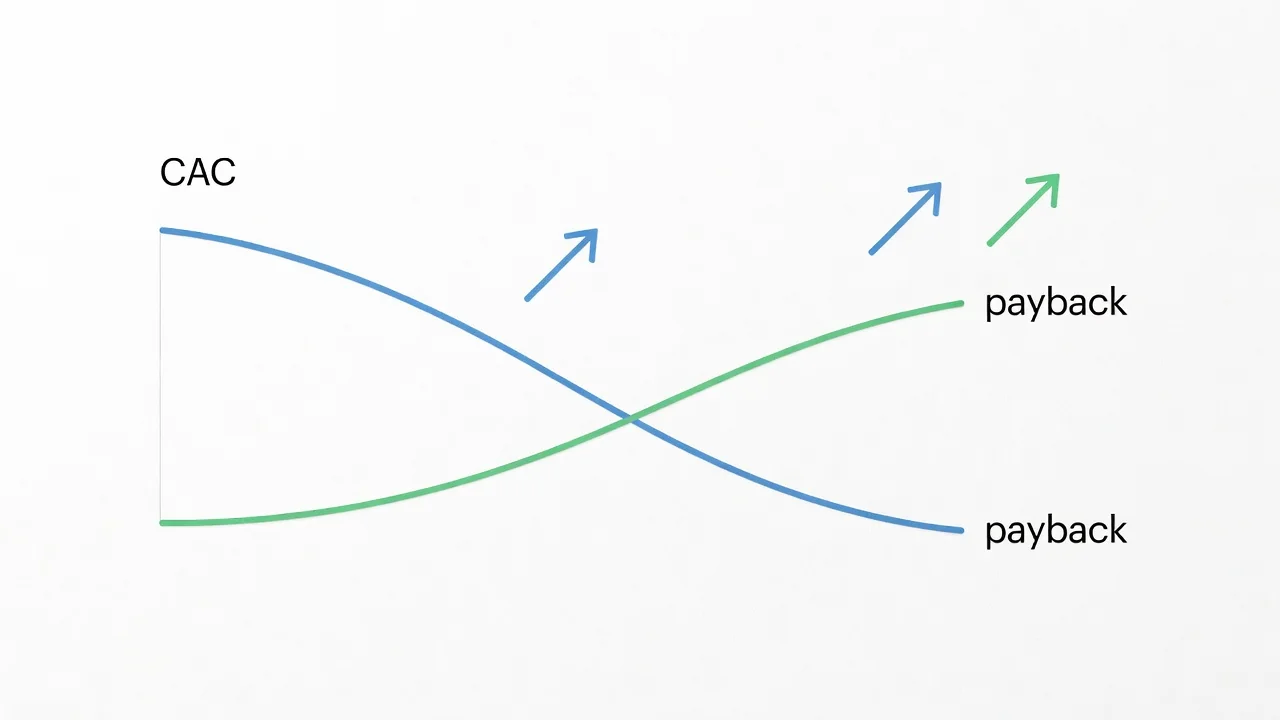
The rule of thumb that still holds: your payback period in months should never exceed one-third of your gross margin percentage. A 75% gross margin business has 25 months of breathing room at the absolute outer limit. Most Series A investors in 2026 are demanding 8 months or less before they even open the data room.
Proven Tactics to Cut CAC Before You Raise
The fastest wins rarely come from ad platform tricks. They come from product-led loops and sharper positioning. Implement a referral engine that rewards both sides with usage credits instead of cash. In B2B SaaS this single move routinely drops CAC by 34% within two quarters. Tighten your ICP so ruthlessly that sales calls convert at 42% instead of 19%. Every extra qualifying question you add to the homepage quiz can shave $40–$70 off blended CAC.
Another repeatable lever: shift budget from cold outbound to community-led growth. Founders who spent the first half of 2025 building private Slack or Discord cohorts are now acquiring net-new logos at under $90 each. The data shows that customers who join a community first have 41% lower support costs and 2.1x higher expansion revenue, improving the entire LTV equation.
Building Your Own CAC Dashboard
Stop relying on last-click attribution. In 2026 the smartest teams run multi-touch models that assign 40% weight to first touch, 40% to last touch, and 20% distributed across middle interactions. Track everything in a single spreadsheet or lightweight BI tool before you hire your first analyst.
| Metric | SaaS SMB | Fintech Consumer | E-commerce DTC | Vertical AI |
|---|---|---|---|---|
| Avg CAC 2026 | $210 | $78 | $34 | $465 |
| Target Payback | 7 months | 4 months | 2.5 months | 11 months |
| Healthy LTV:CAC | 3.8x | 4.2x | 3.1x | 5.4x |
| Blended CAC Reduction Levers | PLG + referrals | Viral loops | Creative testing | Partnerships |
Finally, remember that CAC is a lagging indicator. The real mastery comes from watching leading signals: cost per qualified lead, demo-to-close ratio, and organic traffic contribution. When those three numbers improve, CAC almost always follows. Track them weekly, act monthly, and you will reach your next funding round with metrics that actually impress 2026 investors instead of triggering their gag reflexes.
- Run a full 90-day CAC audit before every board meeting
- Segment paid versus organic acquisition channels religiously
- Calculate payback using gross margin, not revenue
- Test one new CAC-reduction experiment every sprint
- Never celebrate a low CAC without checking retention curves
Master these numbers early and your cap table will thank you later. The founders who treat CAC as a science instead of a spreadsheet cell are the ones still standing when the next wave of capital returns.