
How Much Should You Raise in Pre-Seed and Seed in 2026
In 2026, the startup funding environment has stabilized after years of turbulence. Valuations are more disciplined, investors demand clearer paths to revenue, and founders are thinking harder about how much capital they actually need. The question is no longer “how much can I raise?” but “how much should I raise to hit my next milestone without giving away too much equity?”
The answer depends heavily on your business model, customer acquisition costs, and monthly burn. Whether you’re building a SaaS platform, a marketplace, or a hardware-enabled service, the targets have shifted. Smart founders now model their raises around 18-month runways, realistic growth curves, and concrete proof points that de-risk the business for the next round.
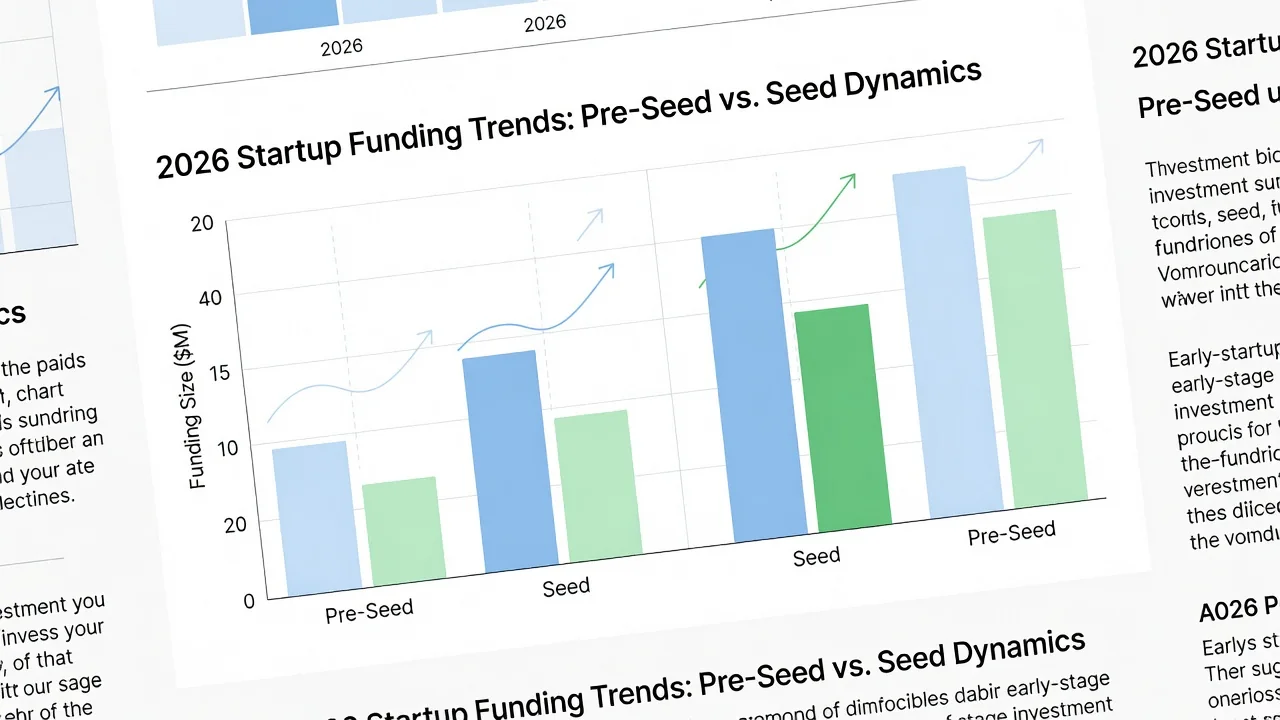
Pre-Seed Targets: Focus on Team and Early Traction
Pre-seed rounds in 2026 typically range from $400k to $1.2M. The sweet spot for most software startups sits between $650k and $900k. This amount usually buys 18–22 months of runway at a monthly burn of $35k–$55k. Consumer apps or hardware startups often need to push toward the higher end because of steeper customer acquisition costs and supply chain expenses.
At this stage, investors care most about founder-market fit, a working prototype, and initial user validation. If you’re still in pure R&D with no paying customers, aim lower and consider grants or angel syndicates to stretch your capital. Monthly burn benchmarks: keep salaries under $28k total, marketing under $8k, and infrastructure below $4k until you have repeatable revenue signals.
Seed Stage: Milestone-Driven Capital
Seed rounds have settled between $1.8M and $3.5M for most teams. B2B SaaS companies with early ARR above $120k are comfortably raising $2.2M–$2.8M at $12M–$18M pre-money valuations. Marketplace businesses or those with physical products often target $2.5M–$4M because their unit economics take longer to prove.
The key math is runway versus milestones. A healthy seed should provide 16–20 months of runway at $90k–$160k monthly burn. That burn rate typically breaks down as 55% team, 20% go-to-market, 15% product development, and 10% operations. Hitting $400k–$750k ARR by the end of the runway positions you well for Series A conversations.
| Business Model | Pre-Seed Target | Seed Target | Target Monthly Burn | Ideal Runway |
|---|---|---|---|---|
| B2B SaaS | $650k–$950k | $2.0M–$2.8M | $65k–$110k | 18 months |
| Consumer Marketplace | $750k–$1.1M | $2.5M–$3.5M | $95k–$150k | 16–20 months |
| Hardware/Deep Tech | $900k–$1.4M | $3.0M–$4.2M | $120k–$180k | 20–24 months |
| AI Tools | $700k–$1.0M | $2.3M–$3.2M | $80k–$130k | 17 months |
Founder Checklist: Raise More, Less, or Bootstrap?
- Do you have 9+ months of runway left at current burn? Consider raising less or delaying.
- Is your monthly burn under $45k with clear product-market signals? Bootstrap longer and raise at a higher valuation later.
- Are customer acquisition costs trending downward and LTV clearly 3x higher? You can comfortably raise at the higher end of the range.
- Will the next round require $1M+ in ARR or 50k MAUs? Build those milestones into your current raise size.
- Have at least two committed lead investors before setting your final ask. Their feedback often reveals whether your target is realistic.
Remember that raising too much can inflate your valuation expectations for the next round and create pressure to spend faster than necessary. Many of the strongest 2026 outcomes came from teams that raised conservatively, stayed disciplined on burn, and used every dollar to generate undeniable traction. Calculate your numbers backward from your next milestone, not forward from what investors might give you. The founders winning term sheets are those who can clearly explain exactly why they chose their specific round size and how every dollar moves them closer to product-market fit or scalable revenue.
The era of blank-check pre-seed rounds is over. Precision and realistic modeling now separate the companies that thrive from those that merely survive the next funding winter.