
How Much Should You Raise in Pre-Seed and Seed in 2026
In 2026, the startup funding landscape has settled into a more disciplined rhythm after years of volatility. Pre-seed and seed rounds are no longer automatic tickets to glory; investors demand clearer proof of traction, tighter budgets, and realistic paths to the next milestone. Founders who understand the current numbers give themselves a significant edge, avoiding the twin traps of raising too little and stalling out, or raising too much and surrendering unnecessary equity.
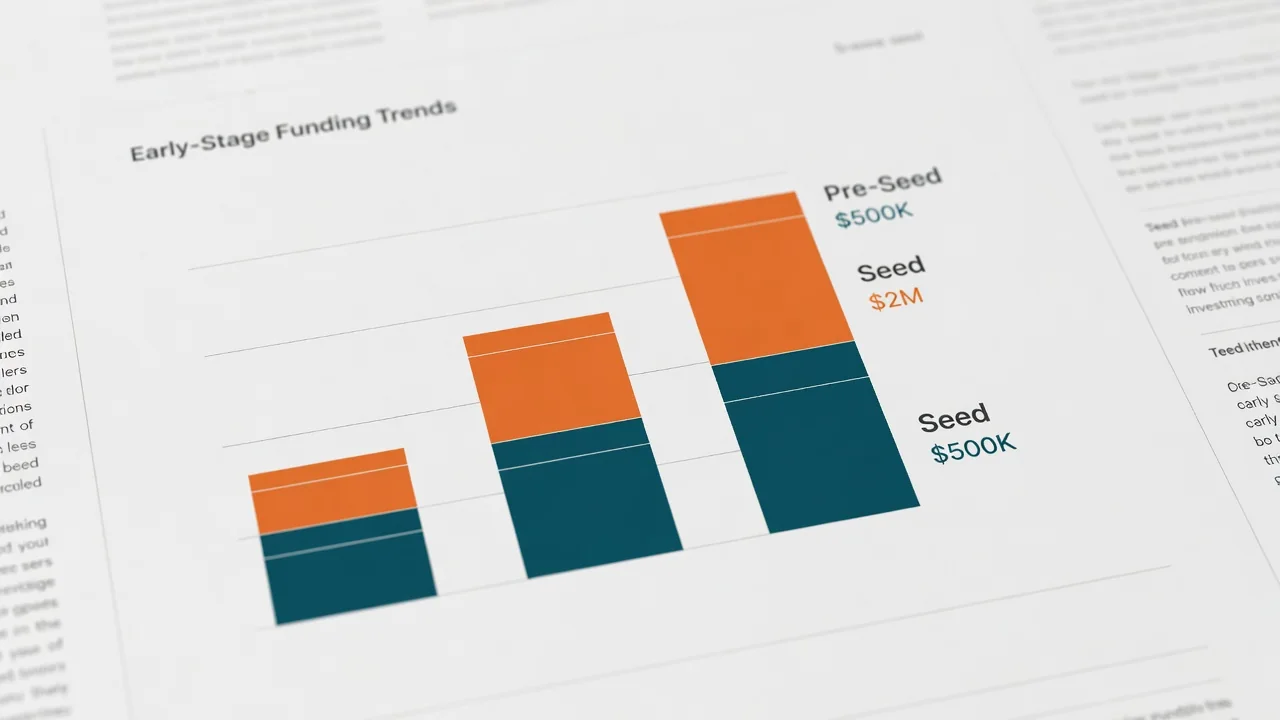
Most pre-seed rounds now land between $750k and $2.2 million, while seed rounds typically range from $2.5 million to $5.5 million. These figures vary sharply by sector. Consumer hardware and deep tech still command larger checks, while pure SaaS and marketplace plays have compressed. The key is matching your ask to both your burn rate and the specific milestones that will make your next round possible.
Industry Benchmarks by Sector
AI infrastructure and climate tech companies are raising the largest pre-seed rounds, often clearing $1.8–2.5M because of high compute and R&D costs. Consumer fintech and vertical SaaS hover around $900k–$1.6M. Healthtech sits in the middle but requires careful staging due to regulatory milestones. The most successful founders we speak with target a post-money valuation that leaves them with 12–18 months of runway after the round, rather than chasing the highest possible number.
| Sector | Typical Pre-Seed | Typical Seed | Median Post-Money (Seed) |
|---|---|---|---|
| AI / Deep Tech | $1.8M–$2.5M | $4M–$6.5M | $18M |
| SaaS / Marketplace | $750k–$1.6M | $2.5M–$4M | $12M |
| Healthtech | $1.2M–$2M | $3.5M–$5M | $15M |
| Consumer / Hardware | $1M–$2.2M | $3M–$5.5M | $14M |
Calculating Your Minimum Viable Runway
Runway remains the single most practical metric. Aim for at least 15 months post-round if you are pre-seed and 12–14 months at seed. This buffer accounts for slower sales cycles and unexpected hiring delays. A solo founder with two part-time contractors might survive on $35k monthly burn, while a five-person team with office space and cloud costs can easily hit $90k. Multiply your realistic monthly burn by 15, then add a 20% contingency. That number should roughly match the round you target.
Many founders under-estimate legal, accounting, and payroll taxes. In 2026 those line items often add $8–12k per month once you pass four employees. Build those in early. Over-raising, on the other hand, can saddle you with unrealistic growth targets and a bloated cap table that makes future rounds painful.
Trade-offs: Dilution, Speed, and Control
Taking a larger seed round can accelerate hiring and marketing, yet every extra million typically costs 4–7% more dilution at current valuations. A $3M seed at $12M post-money leaves founders with roughly 68% ownership after the round if they started with clean cap tables. Push to $5M and that figure drops closer to 58%. The difference matters enormously by the time you reach Series A.
- Raise only what you need to reach the next obvious milestone investors will recognize.
- Build a detailed 18-month cash flow model before you set your round size.
- Leave room for a 15–20% option pool refresh so future hires don’t dilute you further.
- Consider rolling pre-seed SAFEs into the seed to simplify your cap table.
The smartest founders treat fundraising as a strategic dial rather than a one-time event. They run multiple scenarios: what if we raise $1.2M now and prove traction before asking for $4M later? What if we stretch the current round with bridge financing instead? The right answer almost always sits between the minimum needed to survive and the maximum that still leaves founders with meaningful ownership at exit.
Ultimately, 2026 rewards precision. Know your burn, know your milestones, and choose a number that buys you enough time to build something investors cannot ignore—without giving away the farm in the process.